2030 World Cup is Near: Get Your Live Score App Now with Mouad Zizi

Why the 2030 World Cup Is a Different Engineering Problem
The 2030 World Cup — co-hosted across Morocco, Spain, and Portugal, with a handful of centenary matches in South America — is going to put more concurrent load on livescore infrastructure than almost any sporting event before it. If you're building or evaluating a live score app ahead of the tournament, the interesting problems aren't the ones most guides talk about. They're not "should I have push notifications" (yes, obviously). They're about what happens to your app in the 90 seconds after a goal, when every user watching that match opens the app at the same moment.
The Traffic Spike Problem
A typical football season has predictable load: a handful of concurrent matches, spread across time zones, with gradual traffic. A World Cup final (or any knockout match involving a heavily-followed team) is different — you get a single, synchronized spike of opens, refreshes, and notification taps within seconds of a goal or a red card. If your backend polls a livescore API on a fixed interval and pushes updates to clients, the naive version of this architecture falls over exactly when it matters most: at the moment of the goal, when everyone refreshes at once.
Two architectural choices matter here:
- Push over pull. Use WebSockets or a managed real-time layer (Supabase Realtime, Firebase, or a dedicated push service) so the server pushes score changes to connected clients instead of every client polling on its own schedule. This turns a spike of simultaneous requests into a single fan-out from your backend.
- Cache the read path aggressively. Match state (score, minute, cards) changes rarely relative to how often it's read. Cache it at the edge (Cloudflare or similar) with a short TTL and push-based invalidation on actual score changes, rather than hitting your database on every read.
Multi-Language Is Not Optional Here
A World Cup audience is the most linguistically diverse audience any football app will ever see in one event. Fans following co-host nations alone span Arabic, Spanish, Portuguese, French, and English as primary languages — and that's before accounting for the following of every other competing nation. If your app's localization is an afterthought bolted on late, you'll find yourself scrambling. Flutter's built-in internationalization tooling (the `intl` package and ARB files) makes this straightforward if you set it up from the start: string externalization, RTL layout support for Arabic, and locale-aware date/number formatting for match times and stats.
What Fans Actually Want From a Tournament App
- Per-match notification granularity — fans following a World Cup want to opt into specific matches or teams, not a firehose of every goal across 48+ group-stage matches.
- Bracket/knockout visualization — unlike a league season, a World Cup has a bracket structure fans want to see and share, especially once knockout rounds begin.
- Multi-tournament history — comparisons to past World Cups (head-to-head records, previous meetings) add genuine value beyond the live score itself.
Building vs. Buying for a Tournament Timeline
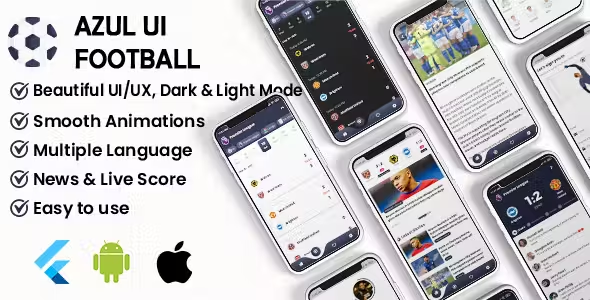
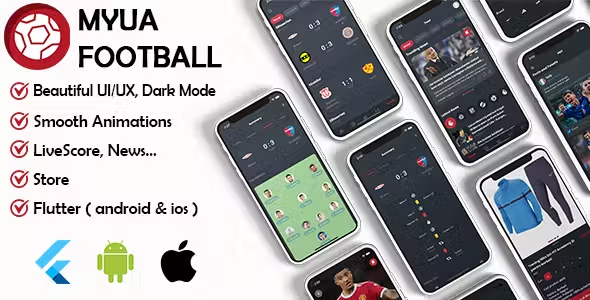
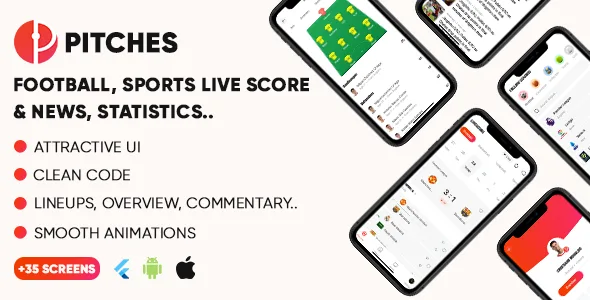
If you're starting from scratch, the realistic build timeline for a fully custom livescore app — real-time backend, Flutter client, admin panel, notification infrastructure — runs 2-4 months for a solid v1. If your timeline to the tournament is shorter than that, starting from an existing, working codebase and customizing it is the more realistic path. I maintain a couple of livescore/sports UI kit options along these lines — Azul Football UI Kit and Scora: Sport UI KIT — both Flutter-based with the live-score screen structure already built, if you want a working starting point rather than building the UI layer from zero.
Conclusion
A World Cup-scale livescore app succeeds or fails on the infrastructure decisions made months before kickoff — push-based real-time updates, aggressive edge caching, and genuine multi-language support from day one. Get those right, and the rest (UI polish, notification copy, bracket visualizations) is the easy part.